BATTLEFIELD 6
The franchise is back. DICE and Battlefield Studios rebuilt the series from the ground up with four classic classes, 128-player maps, full environmental destruction, and the best multiplayer reception in a decade. Out now on PC, PS5, and Xbox Series X/S.
Learn More ↓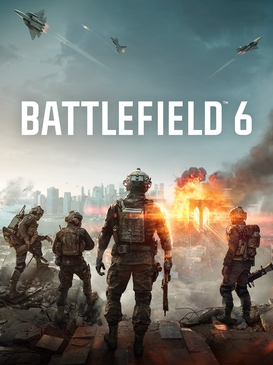
Battlefield 6 is the game Battlefield fans spent four years waiting for after 2042 fell apart at launch. It came out on October 10, 2025, on PC, PlayStation 5, and Xbox Series X/S, and it landed cleanly: no major delays, no catastrophic server collapse, no missing features. DICE and the wider Battlefield Studios collective (Motive, Criterion, and Ripple Effect all contributed) delivered what amounts to a full course correction for the franchise, pulling it back toward the Battlefield 3 and 4 era that most of the community still considers the peak.
The game sold over 7 million units in its first three days, hit a peak of 747,440 concurrent players on Steam alone on launch day (breaking Call of Duty's Steam concurrent record), and opened to an 84 on Metacritic with 90 percent of OpenCritic critics recommending it. That is the strongest critical reception for a Battlefield game in nearly a decade. It is not a perfect game. The single-player campaign is short and narratively uninspired, some map designs divide the community, and the ongoing post-launch seasons carry the usual live-service baggage. But the multiplayer at its core is excellent, and the class system being back makes everything click in a way that 2042 never did.
What Battlefield 6 Actually Is
Battlefield 6 is a large-scale online first-person shooter built around combined-arms warfare: infantry, vehicles, air support, and environmental destruction all happening simultaneously across maps that support up to 128 players. The setting is near-future, specifically 2027 to 2028, where a fractured NATO faces off against Pax Armata, a fictional private military company. The game draws its tone and structure from Battlefield 3 and 4, with a serious military aesthetic that stands in contrast to the more experimental direction of Battlefield V and the chaotic No-Pat theme of 2042.
There is a single-player campaign, developed primarily by Criterion and Motive, but the multiplayer is the real product here. Conquest and Breakthrough return as the flagship modes. Conquest is the classic objective-capping mode where two teams race to drain the opponent's ticket count by holding more flags. Breakthrough is the asymmetric push-and-defend mode where one team tries to capture a series of sectors while the other holds them. Both are back and both work well. New additions include King of the Hill, Domination, and Payload. Battlefield Portal also returns, the sandbox mode that lets you remix content from multiple Battlefield eras into custom rulesets.
On top of the main game, a free-to-play battle royale mode called RedSec launched on October 28, 2025, developed by Ripple Effect Studios. RedSec shares the same seasonal calendar and Battle Pass as the main game, meaning cosmetics and progression flow between the two. This is not a forced add-on: Ripple Effect has built it as a genuine standalone mode, and early Season 1 data showed it pulling real concurrent numbers alongside the base game.
The Class System: Why It Matters
Battlefield 6 brings back four distinct, named character classes, and this is the single most important design decision in the game. The absence of real classes in Battlefield 2042 (replaced by specialist hero characters with overlapping gadgets) was the root cause of most of that game's problems. When everyone can carry a grappling hook and a repair tool, teamwork becomes optional and the emergent coordination that makes Battlefield feel unique disappears. Battlefield 6 fixes this at the structural level by making each class genuinely specialized.
The four classes are:
- Assault: Frontline infantry built for direct engagements. Flashbang grenades and an adrenaline shot for quick self-healing. Best at pushing objectives and trading shots in the open.
- Engineer: The vehicle class. Equipped with an RPG and a repair tool. Engineers keep friendly armor running and are the primary counter to enemy tanks and aircraft. Without Engineers, vehicle players become liabilities instead of force multipliers.
- Support: The logistics class. Suppressive machine gun fire, ammo resupply for teammates, and the ability to revive squad members. Positioned correctly, a Support player extends the effective combat time of the entire squad.
- Recon: Long-range and intelligence. Scoped rifles, C4, a scouting drone for spotting enemies, and a laser designator for calling in guided munitions. Recon players who actually use the drone and designator have an outsized impact on how the match flows.
The class restrictions extend to weapons. Each class has a primary weapon pool it can access, with some crossover options. You can build toward your own playstyle within a class, but you cannot simply spec the Engineer with a sniper rifle and play it as a Recon. That constraint is the point. It forces a degree of role commitment that creates natural teamwork without requiring any explicit coordination.
Maps, Destruction, and the World
Battlefield 6 launched with maps set across multiple real-world-inspired locations including Cairo, Brooklyn, and Gibraltar. The map list has grown significantly since launch through the seasonal content model. Season 3: Pax Armata, which went live on May 12, 2026, added Railway to Golmud, a reimagined Battlefield 4 map set in Tajikistan described by the developers as the largest map in Battlefield 6 to date, surpassing everything that shipped at launch.
Environmental destruction is central to how the maps play. Buildings collapse under sustained fire. Walls can be breached to open new sightlines. Cover that exists at the start of a match may be rubble by the end of it. This is the system that has defined Battlefield's identity since Bad Company 2 in 2010, and it is implemented here on a scale that matches the 128-player server capacity. A match on one of the larger Conquest maps, with tanks, aircraft, and full infantry engagement all running simultaneously, genuinely produces moments you cannot manufacture in any other shooter.
The community has been more divided on map design quality than on the core systems. Several of the launch maps drew criticism for chokepoints that funnel infantry into predictable lanes rather than giving vehicle players and Recon the open space they need to operate effectively. DICE has acknowledged this feedback. Post-launch balance patches and the Season 3 additions suggest the studio is actively addressing it, and the Railway to Golmud addition in particular is a direct response to requests for larger, more open maps.
The Single-Player Campaign
The campaign was developed primarily by Criterion and Motive, with Motive citing the films Lioness and Civil War as inspirations. The story follows an elite squad of Marine Raiders fighting Pax Armata across missions that take place in environments including the Sahara, Gibraltar, and New York. On paper this is the kind of globe-trotting military action that made Battlefield 3's campaign memorable for its set-pieces if not its story.
In practice, critics were split. IGN gave the campaign a 5/10, calling it "a safe, dull reimagining of what Battlefield once was, rather than a bold reinvention of what it could be." Console Creatures gave it a 6/10 and noted it was "brief and forgettable, lacking both memorable setpieces and meaningful statements." GamingTrend was far more generous at 9/10, writing that the campaign "gets the job done" and that the overall package is easy to recommend. The honest summary is this: the campaign is a competent but short single-player mode that exists to serve players who want some context before jumping into multiplayer. If you are buying Battlefield 6 primarily for its campaign, you should read a few reviews carefully first. If you are buying it for multiplayer, the campaign is a bonus and the multiplayer is the reason.
Development History: Four Studios and a $400 Million Budget
The story behind how Battlefield 6 got made is almost as interesting as the game itself. After Battlefield 2042 launched in November 2021 to widespread criticism for missing features, technical issues, and the abandonment of the class system, Electronic Arts brought in Vince Zampella, the co-creator of Call of Duty and head of Respawn Entertainment, to take overall leadership of the Battlefield franchise. EA reorganized its Battlefield development teams under a new umbrella called Battlefield Studios, with DICE handling multiplayer, Motive contributing map design and campaign missions, Criterion building the narrative campaign, and Ripple Effect developing RedSec.
Development of Battlefield 6 was not smooth. An Ars Technica report from July 2025 described significant challenges including team burnout and exhaustion, cultural clashes between the four studios working under the Battlefield Studios banner, unrealistic sales expectations from EA leadership, and a development budget that ballooned far past $400 million. For context, even a budget in that range would make Battlefield 6 one of the most expensive games ever produced. EA has not confirmed a specific figure.
Vince Zampella died in December 2025, after the game had shipped. Battlefield 6 was the last game he oversaw, and the internal culture he worked to establish is now the foundation the remaining team is building its post-launch seasons on. The game launched without a delay, made its October 10 date cleanly, and sold 7 million copies in three days. Whatever the internal difficulties were, the product that shipped reflects a substantial recovery from where the franchise was in 2022.
Seasons, Live Service, and What Is Happening Now
Battlefield 6 uses a seasonal content model with each season split into three free content phases released roughly four weeks apart. This structure is a deliberate departure from the single-drop season model used in games like Call of Duty, designed to maintain regular activity spikes and keep the player base engaged between major updates.
As of June 2026, the game has shipped three full seasons:
- Season 1 (October 28 to February 17, 2026): The launch season, which ran 112 days and also introduced RedSec.
- Season 2: Extreme Measures (February 17 to May 12, 2026): The first standard-length season at 84 days, which became the cadence DICE confirmed it plans to maintain through 2026.
- Season 3: Pax Armata (May 12 to August 28, 2026): Currently live. Features Railway to Golmud, a reimagined Battlefield 4 classic, as its centerpiece map drop.
Season 4 is confirmed for July 2026 and brings back naval warfare and Wake Island, the latter being one of the most requested classic Battlefield maps. Season 5 is planned for fall 2026. The 2026 roadmap was disclosed by Battlefield Studios in April 2026. The phased content model has generally worked: player counts spike with each phase drop and the game has maintained active server populations well beyond what 2042 managed at equivalent post-launch intervals.
The anti-cheat system, EA Javelin, deserves a mention because it has practical implications for PC players. Javelin is kernel-level and requires Secure Boot and TPM 2.0 to be enabled on your system. This means the game will not run on the Steam Deck, and most Linux configurations are also effectively locked out. EA claimed by August 2025 that Javelin had blocked over 300,000 cheat attempts. There was also a reported conflict during the open beta between Javelin and Riot Vanguard, Valorant's anti-cheat, specifically that Battlefield 6 did not allow the Valorant launcher to be running simultaneously. Riot confirmed Vanguard and Javelin can technically coexist but that BF6 itself blocks the Valorant launcher. If you play both games on the same machine, you will need to close one launcher before opening the other.
Price, Editions, and Where to Buy
Battlefield 6 costs $69.99 for the Standard Edition on all platforms. EA held the line at this price point when other publishers were pushing $80 for new releases, which was noticed and appreciated by the community going into launch. There is no confirmed $80 premium or Deluxe edition listed for the base game, though preorder bonus cosmetics were available ahead of launch.
On PC, Battlefield 6 is available through three storefronts: Steam, the EA App, and the Epic Games Store. If you purchase through Epic, you will need to launch the game through the EA App rather than directly through Epic's launcher. Steam purchases launch directly without this detour. An EA account is required to play regardless of which storefront you use. RedSec, the battle royale mode, is free-to-play and available separately.
The game is also available on console via the PlayStation Store (PS5) and Xbox digital marketplace (Xbox Series X/S). Console players can hit up to 120 fps according to EA's pre-launch confirmations, making it one of the few games that genuinely targets high refresh rate on current-generation hardware.
Who Should Buy Battlefield 6 and When
If you liked Battlefield 3, Battlefield 4, or Bad Company 2, this is the closest the franchise has come back to that era in a long time. The class system being restored is not cosmetic: it changes how the game fundamentally plays, and if you remember what it felt like to roll a tank with an Engineer squad keeping it repaired while Recon dropped artillery coordinates, that dynamic is back. The maps have improved with each season, and Season 3's railway map is widely considered the best in the game so far.
If you play primarily for single-player campaigns, Battlefield 6 is a harder sell. The campaign exists, it is competently made, but most reviews clock it between five and seven hours and the story does not leave much of an impression. You are not buying this game for its narrative.
If you are new to Battlefield entirely and wondering whether it is worth jumping in mid-season, the answer is broadly yes. The seasonal structure means there is always active content, the player base has remained healthy, and the matchmaking pools are large enough that you are not waiting long for games. The learning curve is real: if you do not understand the class system and vehicle interaction, you will have a rough first few hours. Stick with it past that point and the depth becomes clear.
The one group who should wait is Steam Deck players. Javelin's Secure Boot requirement means the game simply does not run on Deck right now, and EA has given no indication this will change. If Steam Deck is your primary gaming device, Battlefield 6 is not currently an option for you.
System Requirements
Note: Battlefield 6 requires Secure Boot and TPM 2.0 to be enabled for the Javelin anti-cheat system. The game will not run on Steam Deck or most Linux configurations due to this requirement. DLSS and FSR upscaling are both supported.
We do NOT host, sell, or distribute this product. This link takes you to the official source.